
The legal, social, and moral implications of street photography
One of the major disciplines of photography is portraiture, in which the photographer takes a photo of another person, typically for compensation. When taking a picture of a model, the photographer typically negotiates a modeling contract which spells out the terms, conditions, and rates for the model’s time, image, and likeness. This is a commercial transaction with well-defined boundaries; there may be restrictions on the usage of the model, and there may be restrictions on the model’s usage of the photographer’s pictures.
Generally, however, both parties complete a modeling agreement with the expectation that there is commerce involved and that this is arrangement has been made with consent. Legally, it could be very tricky if a photographer were to take a photo of a model and use it to make money without the model’s permission – using the model’s likeness in commerce. The model could, in theory, pursue legal action to either prevent this from happening, or to recoup any money the photographer has made from their likeness.
Yet, two other major disciplines of photography do just that – use other people’s images to make money, often without their consent. Those two types are journalism and street photography. Journalism is considered not for commerce, despite the fact that journalists make money from their work, the news organizations make money from their work, and the media moguls – often multi-billionaires who own several news organizations – make a great deal of money from the likeness of others. In the United States, the First Amendment to the Constitution provides;
“Congress shall make no law respecting an establishment of religion, or prohibiting the free exercise thereof; or abridging the freedom of speech, or of the press; or the right of the people peaceably to assemble, and to petition the Government for a redress of grievances,”
– which also extends to press photography. It is generally accepted, after 250 years of case law, that photojournalists in the US may take photos of others in areas where someone would have no reasonable expectation of privacy; in public, in plain view, and when the photographer does not violate the unwitting model’s privacy. The International Freelance Photographer’s Organization advises, however, “the freelancer must exercise caution in selling photographs to a publication.” This addresses both the issue that the photographer loses the commercial rights to their photograph after selling it, and that selling someone else’s image without consent can cause both legal and civil problems.
What about street photography? First, there are no legal categories of photographers; anyone who takes photographs is a photographer, and anyone who makes money from their photographs is a commercial, even professional, photographer. Similarly, there is no legal category for press photographers. Having a press card provides no legal immunity – as many photojournalists can tell you. However, anyone taking photos on the street enjoys the same protections (and lack of protections) as any press photographer, which includes the protections provided in the US Constitution.
Henri Cartier-Bresson, who could be called the inventor of street photography, took portraits of many famous individuals, with their consent; Sartre, Matisse, Truman Capote, Ezra Pound. Cartier-Bresson also acknowledged that photography is conflict; taking a photograph is a duel, a ‘tête-à-tête’, an often-tense conversation between the photographer and the model. When taking photos on the street, the model is often not capable of giving consent due to a lack of awareness that their photo is being taken. Cartier-Bresson, similarly, took many photos of others without their consent. He famously used zone focus, where the photographer picks an area of a known distance, focuses on it, uses a narrow enough aperture to create sufficient depth of field, and then waits for action to happen in this zone. This was part of Cartier-Bresson’s philosophy of the decisive moment – the time and place where everything came together in a split second.
With a wealth of case law, personal rights, and social mores in mind, I took up my camera and decided to take some photos.
Portland
Portland is one of my favorite cities. It’s an eclectic mix of people with different interests and backgrounds, but manages to have its own culture that, honestly, I find fun. I wandered around the city with a Canon AE-1 Program, shooting some expired Fujifilm Superia 400. Expired film doesn’t mean that the film is bad, or that it won’t take photos; generally, it means that there will be some color shifts, extra grain, and a little less light sensitivity.
This shot shows two people conversing; one in a safety vest, and one on their phone. It doesn’t say anything about them. The green color cast in the shadows is due to the scanner type.

Two people conversing on the street in downtown Portland, Oregon. Shot on Fujifilm Superia 400 with a Canon AE-1 Program. Photo by Benjamin Wilson.
Bend
Bend is another fun town in Oregon. It is a little closer to nature, a little more outdoor recreation focused, and a little less city-centered. It’s also known, colloquially, as the mountain biking capitol of the northwestern United States, and it truly does have a lot of mountain bike trails, as well as pedestrian-friendly trails throughout the city.
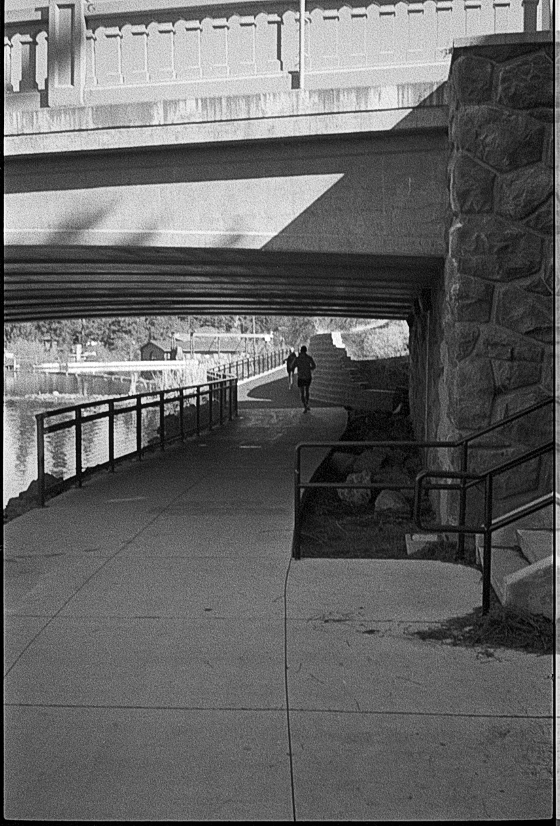
Two people jogging around Mirror Pond, Bend, Oregon. Shot on Tri-X 400 with a Leica CL. Photo by Benjamin Wilson.
Jacksonville
Jacksonville, Oregon, is an interesting town nestled amidst vineyards, with a historic downtown area and a wealth of nearby recreation opportunities. For this shoot, I brought a camera from 1941; a Kodak Brownie Target Six-Twenty. After cleaning and doing some minor repairs on the Brownie (80 years is a lot for a machine), I managed to track down some 620 film, and went to play around with the camera. It has two viewfinders, consisting of small lenses and mirrors – none of which are exactly accurate. To visualize your photo, you have to compose at slightly higher than bellybutton level, peeping through the viewfinder lenses. There is no focus, there is a bent steel rod that comprises the aperture selector, and there are no other controls other than film advance and the shutter. Shutter speed is, also, not selectable. I gave up trying to make any advanced compositions relatively early on, and just… took some shots. For more details, see this video;
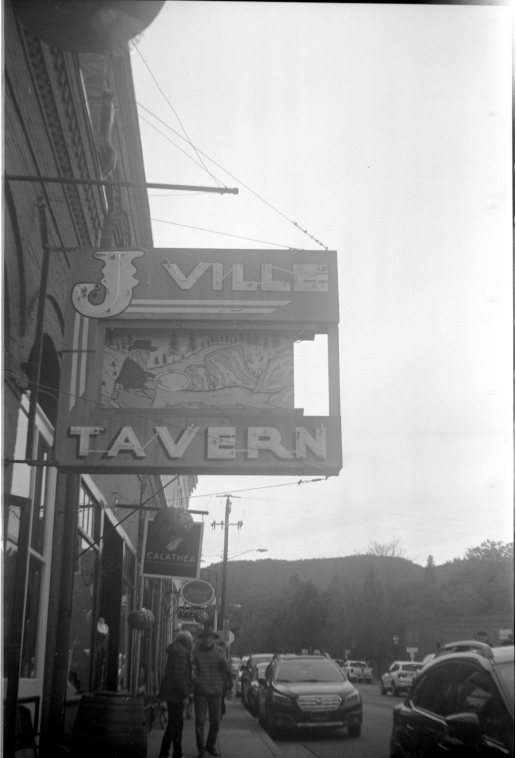
Two people outside of the Jville tavern, Jacksonville, Oregon. Shot on Tri-X 400 with a Kodak Brownie Target Six-Twenty. Photo by Benjamin Wilson.
There are many times when it is most likely legally permissible to take photos of people without their consent – in public places, in most jurisdictions. However, it’s always the photographer’s responsibility to determine when it’s acceptable and when it’s not. And if someone asks you not to take their photo, in most cases it is preferable to just work with them, rather than asserting that you have a right to take their photo in a public place. But, you do you; photography is, in its entirety, an expression of the photographer. Sometimes the duel between photographer and subject becomes more literal and less metaphorical, especially in tense political climes.
Works Cited
Cartier-Bresson, Henri. Images à la Sauvette. London: Thames & Hudson, 2024.
IFPO. Photographer’s Ethics and the Law. n.d. 11 March 2026. <https://www.ifpo.net/photographers-ethics-and-the-law/#:~:text=In%20general%2C%20a%20press%20photographer,museums%2C%20or%20other%20public%20arenas.>.
“United States Constitution.” Amendment I. n.d.
Leave a Reply