Why shoot film? Seriously, why bother? Film is grainy, it’s hard to find, developing is a pain and costs you $20 for a roll that you won’t see for three weeks. You end up with a drawer full of expired film stock and a collection of old cameras that may or may not work – and if they break, you can only get them repaired at a less-than-social shop somewhere near Fargo. Digital cameras are convenient, shoot beautifully smooth images, and you already have one in your pocket.
On the other hand, photography is an art form. It is also a science – in much the same way that formulating pigments for oil painting is a science. But it is, indisputably, art. Photos can also be a form of documentation, a form of note taking, or a way to commemorate an occasion. Asking ‘Which art form is better?’ is naïve at best – there is no better or best when it comes to art. There is only the form that allows the artist to express themselves in the way that they feel is right.
Digital photos can also be an art form, and they have many benefits; they often require very little maintenance, the workflow is very easy, SD cards are smaller than rolls of film, and if you’re a working professional, you can take a photo and have it to your editor or art director in record time. Cameras from Fuji, Sony, RED, Blackmagic Design, and other manufacturers can even shoot digitals directly to a cloud workflow – so an editor can get your stills and video files while you’re still in the field. Talk about convenient. Digital cameras are reliable, fast, and convenient – the photographic equivalent of reliable, efficient cars. They’ll get you to work, they probably won’t break down very often, and they’ll even get you to the beach on the weekend. They just aren’t very exciting.
Film photography is fun. Successfully developing photos that you took with an 80-year-old camera is incredibly exciting; unpredictable, sometimes disappointing, but exciting. Film is not as reliable as digital; exposures just don’t turn out sometimes. If you’re shooting with a rangefinder, you may miss focus. If you’re shooting with an electronic film camera, you may suffer malfunctions. But seeing the exposures exposed, composed, and developed well is just fun.
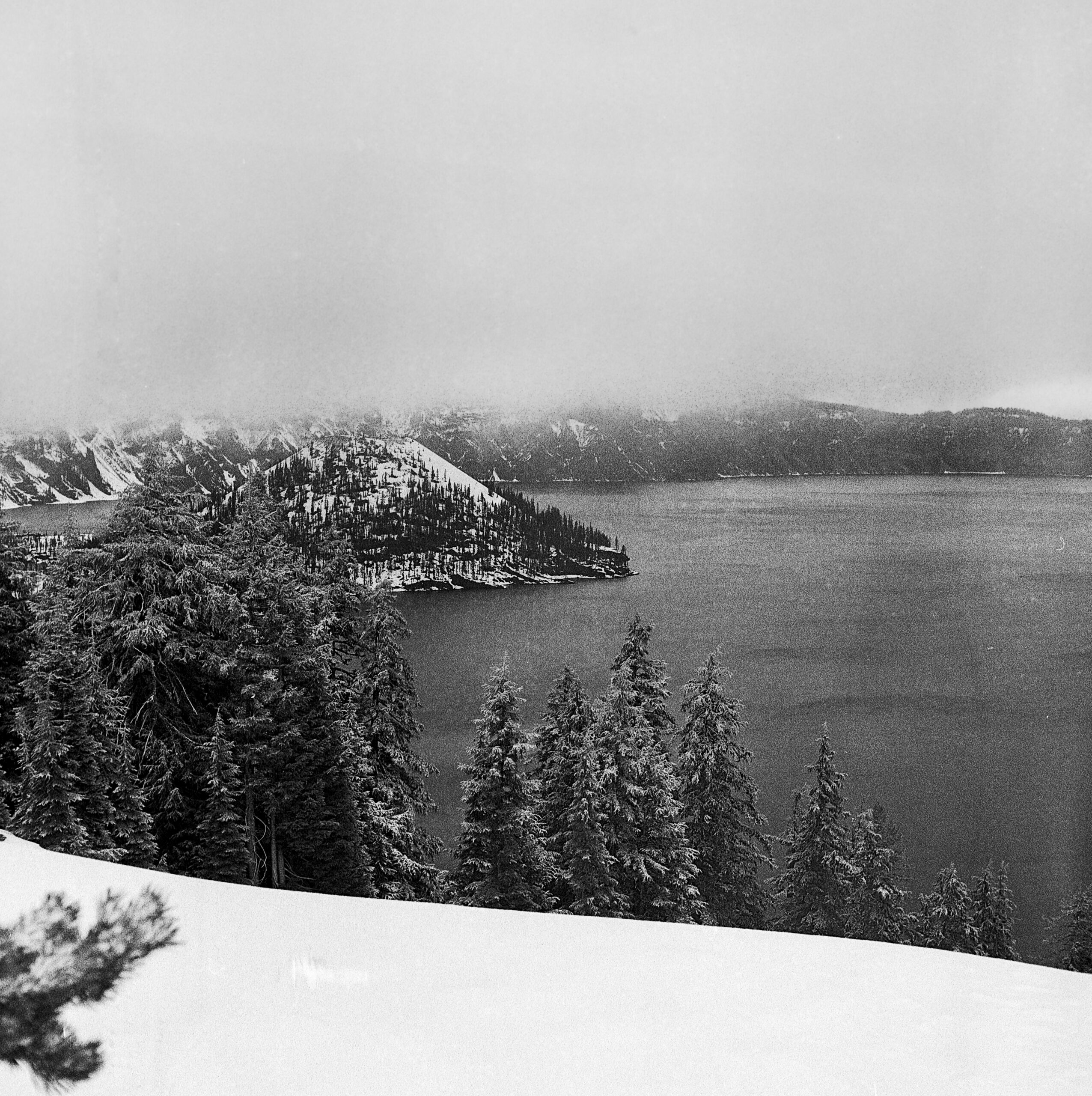
I decided to have some fun and took a Rolleicord Va to Crater Lake National Park. This winter (2026) has been fairly inconsistent, weather-wise, but the snow levels at Crater Lake have been pretty low, which means that it’s not all that difficult to get up to the rim and shoot a few exposures. Typically, trees near the rim get in the way of the panoramic view of the lake; put some snow on the ground and you have a natural ladder.
On the way to Crater Lake, I stopped by Annie Creek – a body of water that flows down from the lake, generally heading south-east. There are some visually interesting structures along the creek, and in places they look grand.
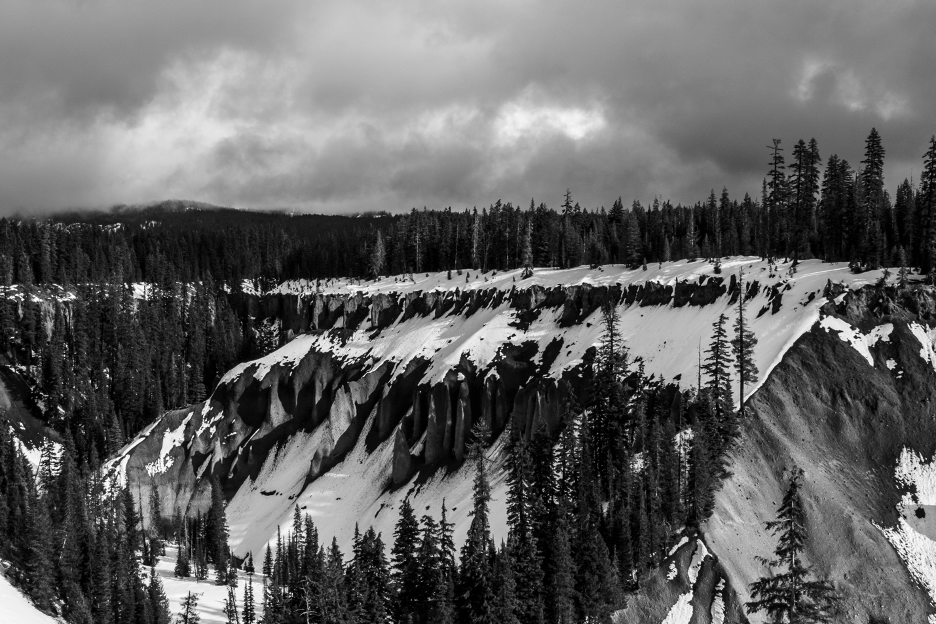
Annie Creek with sand pinnacles and snow. Shot with a Fujifilm X-T5 digital camera. Photo by Benjamin Wilson.
When I got to the rim, there was about 3’ of snow, which is still enough to get a decent view, and the temperatures weren’t all that cold. I did experience one of those aforementioned equipment issues; my Rolleicord, being a pretty old camera, experienced a sticking shutter. Mechanical shutters depend on things like lubrication and springs; lubricants like oil tend to change viscosity as the temperature changes. Still, I managed to compensate enough to grab a few shots.

Wizard Island, Crater Lake National Park. Shot on Tri-X 400 film with a Rolleicord Va. Photo by Benjamin Wilson.
As I was heading down the mountain, I saw evidence of cars that went offroading on an unscheduled basis (read: ran into the snowbank); packed snow and ice can do that. When you’re traveling in the winter, especially in the mountains, it pays to prepare;
- Get your vehicle serviced. Cars break down in the winter very often.
- Carry chains or use traction tires. The 3-peak mountain snowflake (Tirerack.com) on tires is your friend.
- Keep a full tank of gas.
- Carry an emergency supply kit (Ready.gov).
- Check the road conditions before you go.
Just because you’re a badass film photographer doesn’t mean you can’t get stranded. Be responsible – for yourself and your passengers – and have fun.
Bibliography
Ready.gov. Car Safety. n.d. March 2026. <https://www.ready.gov/car>.
Tirerack.com. What is the Three-Peak Mountain Snowflake Symbol? n.d. 13 March 2026. <https://www.tirerack.com/upgrade-garage/what-is-the-threepeak-mountain-snowflake-symbol>.
Leave a Reply